Last updated: August 21, 2026
You break a serger needle on a Sunday, walk into a craft store, and stand in front of a wall of little green and blue boxes that all say sewing machine needles. None of them say serger. You buy the one that looks closest, get home, and now you are not sure whether the machine is going to work or whether you have just made it worse.
Here is the good news. Most home sergers take the same flat shank needle your sewing machine takes, and the manual will tell you in one line. A few take a serger specific system instead, and putting the wrong one in is the reason a machine suddenly skips. This guide sorts out which is which and what to keep in the drawer.
This article contains affiliate links. If you buy through them, we may earn a commission at no extra cost to you. Learn more.
Quick Answer
Which needles fit a home serger?
- Check the manual first. Brother’s 1034D handbook calls for SCHMETZ 130/705H, the ordinary flat shank household needle.
- Juki lists the MO-654DE as taking household HAx1 needles in sizes 11 to 14, which is the same flat shank family.
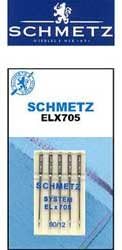
- Some machines specify ELx705 instead, a serger system with a groove front and back and a bigger scarf.
- Size 80/12 and 90/14 cover most work, in ballpoint for knits and sharp for wovens.
Bottom line: the manual decides the system, you decide the point and the size. Change needles more often than feels necessary, because a serger runs two of them at once.
The One Line in Your Manual That Decides It
Every serger manual has a needle line in the specification table, and it is the only authority worth trusting here. Brother’s 1034D handbook specifies SCHMETZ 130/705H, the same universal household needle a domestic sewing machine takes. Juki’s product page for the MO-654DE lists needles as household HAx1 in sizes 11 to 14.
Those two designations describe the same physical thing: a needle with a rounded front and a flat back on the shank, which is why it can only go in one way round. If your manual says something starting with EL instead, that is a different system and you cannot substitute a household needle for it.
If You Do Not Have the Manual
Most manufacturers put manuals on their support site by model number, and that is a better source than a forum thread about a machine that looks like yours. Take the needle that is currently in the machine to compare, but do not assume the previous owner had it right, especially on a second hand machine.
Household 130/705H Versus ELx705
The difference is real, not branding. SCHMETZ describes its ELx705 serger needles as having a long groove on both the front and the back of the blade plus a slightly larger scarf, where a household 130/705H has a single front groove. The chrome finish version, ELx705CF, is finished to reduce heat and wear.
That second groove and the deeper scarf give the looper more room to catch the thread loop at high speed, which is exactly the moment a serger drops a stitch. SCHMETZ also describes the ELx705 blade as reinforced, so it takes more side load before it bends.
Can You Put ELx705 in a Machine That Asks for 130/705H
Many sewers do, because the shank shape matches, and they report fewer skipped stitches in stretchy fabric. It is not something we will tell you to do blind, because needle length and scarf position vary between systems and only your manufacturer knows what the hook timing on your model expects. If the machine is under warranty, run what the manual specifies.
Point Shape Matters More Than Brand
The point is what decides whether the needle cuts the fabric or pushes between the threads of it. A sharp or universal point is right on wovens. A ballpoint or jersey point pushes the knit loops aside instead of severing them, and severed loops are what cause a ladder of runs down a t-shirt seam weeks later.
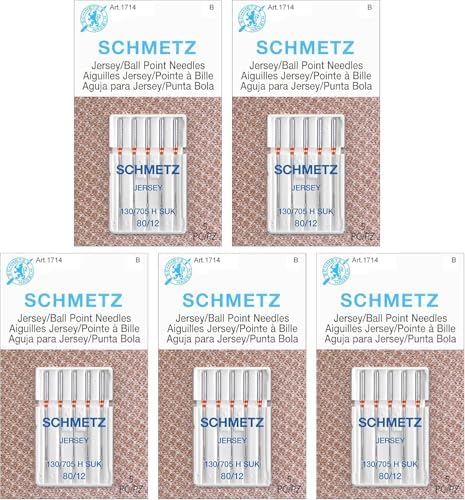
SCHMETZ makes the ELx705 in a medium ball point specifically for this reason. In the household system, the same choice is between a universal needle and a jersey or stretch needle. Our ballpoint versus universal guide explains where the line sits.
Sizes and What They Suit
Two sizes cover most sewing. Go finer for lightweight knits and silky wovens, heavier for denim and canvas. The metric number is the blade diameter in hundredths of a millimeter, so 80/12 is thinner than 90/14, and the second number is the American equivalent.
| Size | Point to choose | Fabric | Notes |
|---|---|---|---|
| 75/11 | Universal or ball point | Fine jersey, lightweight wovens, lining | Matches the fine cone thread most sergers run |
| 80/12 | Universal for woven, ball point for knit | Cotton shirting, medium jersey | The default for everyday garment work |
| 90/14 | Universal or ball point | Sweatshirt fleece, twill, heavier knits | Brother’s 1034D handbook lists 80/12 and 90/14 |
| 100/16 | Sharp | Denim and canvas seam finishing | Check your manual allows it before fitting |
The sizes above follow the standard needle numbering used by SCHMETZ and the machine manuals quoted in this article. Your own manual may cap the size, and that cap is not a suggestion.
What to Keep in the Drawer
A serger uses one or two needles at a time and both should be changed together, so needles get used up faster here than on a sewing machine. Keep two packs of your everyday size, one sharp and one ballpoint, and replace them before a big project rather than during it.
If Your Manual Specifies the Serger System
ELx705 in chrome finish is the standard choice, and it comes in sharp and medium ball point versions. Buy the size your manual lists rather than the size you use in your sewing machine, because a serger seam sits at the edge where a heavy needle shows.
If Your Manual Specifies Household Needles
Ordinary 130/705H universal needles are what a Brother 1034D and many Juki home sergers ask for, and they are the cheapest needle in the shop. Buy a multipack of sizes so you are not stuck at nine on a Sunday evening.

For Knit Fabric
A ball point in whichever system your machine takes is the single change that removes most skipped stitches in jersey and interlock. Fit two fresh ones before you start a t-shirt run rather than swapping mid seam.
The Tool That Saves Your Temper
Serger needle bars sit deep behind the looper cover and the setscrews are small. The little L shaped hex driver that comes with the machine is the first thing to disappear, and a tweezer plus a spare driver makes a needle change a two minute job instead of a fifteen minute one.

Fitting a Needle Without Making It Worse
Turn the machine off at the switch before your hands go near the needle bar. Loosen the setscrew, drop the old needle out, and push the new one up until it stops, flat side to the back unless your manual says otherwise. Not quite far enough is the most common installation fault and it produces exactly the same symptoms as a worn needle.
Two needle machines have a left and a right needle, and on many models they sit at slightly different heights by design. Take one out at a time so you can see which position you are working in, and if you are running a three thread stitch, check the manual for which needle stays in. If a fresh, correctly fitted needle still skips, work through the serger skipped stitch checklist before you blame the machine.
Frequently Asked Questions
Are serger needles different from sewing machine needles? Sometimes. Many home sergers take the ordinary household 130/705H flat shank needle, and Brother’s 1034D handbook specifies exactly that. Others use the ELx705 serger system, which SCHMETZ describes as having grooves front and back and a larger scarf.
How often should I change serger needles? Change both needles at the start of a project and again if you hear a punchy sound, see skipped stitches, or notice pulled threads on knit. A serger runs at speed with two needles, so they dull sooner than you expect.
Can I use a jeans needle in a serger? Only if your manual allows that size and system. Sergers are for finishing edges rather than sewing through the thick part of a denim seam, and a heavy needle at the edge leaves visible holes in most fabrics.
Why does my machine skip only on knits? That is the classic sign of a sharp point in a knit fabric. Fit a ball point in your machine’s system and the skipping usually stops. Our needle guide covers the point shapes in more detail.
Do both needles have to be the same size? Yes for normal sewing. Different sizes in the left and right positions change the stitch balance and the loopers will not pick up cleanly from both.
The Bottom Line
Find the needle line in your manual, buy that system, and then choose the point for the fabric rather than the price. Household 130/705H covers a large share of home sergers including the Brother 1034D, ELx705 is the serger specific alternative with the second groove, and a ball point in either system is what stops knits from skipping. Keep two sizes in the drawer and change both needles together. Read next: our needle sizes and points guide and the Brother 1034D review.