Last updated: August 22, 2026
Needles are the cheapest part of a sewing machine and the one that causes the most trouble. Skipped stitches, shredded thread, puckered seams, snagged knits and small holes along a hem all trace back to a needle that was blunt, too fine, too heavy, or simply the wrong point for the cloth.
The system looks confusing because packets carry two numbers and a type name, but it is smaller than it appears. There are two number systems for one measurement, and about six point shapes that cover almost everything a home sewer touches. Learn those and you stop guessing at the shop shelf. This guide covers the sizes, the points, which packs are worth keeping in the drawer, and how to know when a needle is finished.
This article contains affiliate links. If you buy through them, we may earn a commission at no extra cost to you. Learn more.
Quick Answer
Which sewing machine needles do you actually need?
- A universal assortment in 70/10, 80/12 and 90/14 covers most woven fabrics and is the pack to own first.
- A jersey or ballpoint pack for knits. Schmetz recommends jersey 70/10 to 90/14 for cotton knits and stretch 75/11 for springier ones.
- A jeans pack for denim and canvas. Schmetz recommends jeans needles at 90/14 to 110/18 for both.
- Add microtex for fine and coated fabrics, and leather needles only if you sew leather.
Bottom line: the first number is the European size, the second is the American one, and the point shape matters more than either.
What the Two Numbers Mean
A packet marked 80/12 is one needle with two size labels. Schmetz explains the European figure directly: it measures the diameter of the blade and multiplies it by one hundred, so a blade of 0.80 millimeters becomes size 80. The second number is the American equivalent for the same needle.
Sizes run from 60/8 at the fine end through 65/9, 70/10, 75/11, 80/12, 90/14, 100/16, 110/18 and 120/19 at the heavy end. Lower means finer. The size follows the weight of the fabric and the thickness of the thread, and Schmetz pairs a 40 weight thread with an 80/12 and moves up to 90/14 or 100/16 for heavier thread.
The Color Bands on the Shank
Schmetz color codes its needles so you can identify a loose one. The top band identifies the needle type and the lower band identifies the size, with universal needles carrying only the size band. That is worth knowing, because a needle that has been sitting in the pincushion for a year is otherwise unidentifiable.
Point Shape Is the Bigger Decision
Size decides whether the needle can get through. Point shape decides whether it does so without damaging the fabric or missing the stitch. Getting the point right fixes more problems than getting the size right, and it is the part most people skip.
A sharp point pierces yarns, which is what a woven fabric wants and what a knit does not. A rounded point pushes between yarns, which is what saves a jersey from laddering. A wedge point cuts, which is how leather gets sewn. Everything else is a refinement of those three ideas for a particular material.
The Packs Worth Owning
You do not need every type. Four packs cover almost everything a home sewer does, and the fifth is only relevant if you sew a specific material. Buying assortments rather than single sizes is what stops you forcing the wrong needle through something because it happened to be in the machine.
Start Here: A Universal Assortment
Universal needles have a slightly rounded point that works on most wovens and copes with many knits. An assortment spanning 70/10, 80/12 and 90/14 handles cotton wovens, poplin, linen, quilting cotton and general repairs. Schmetz recommends universal 70/10 to 90/14 for cotton wovens and 70/10 to 90/14 for linen, which is the bulk of a normal sewing week.

For Knits and Anything Stretchy
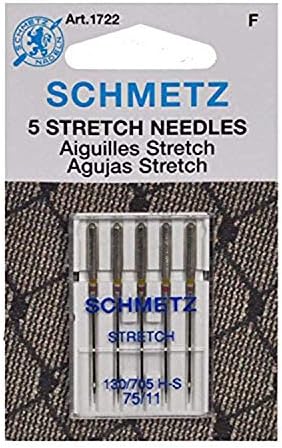
This is the pack that solves the most complaints. A jersey needle has a medium ball point that slides between knit loops instead of cutting them, which stops both the skipped stitches and the little ladders that appear along a T shirt hem. Schmetz recommends jersey 70/10 to 90/14 for cotton knits and sweatshirt fabric, and stretch 75/11 for lycra and silk jersey.
For Denim, Canvas and Bag Making
Jeans needles have a strong blade and a sharp point built to get through dense weaves without deflecting. Schmetz recommends jeans needles at 90/14 to 110/18 for both denim and canvas, and twill sits in the same family. This is also the pack that stops needles snapping on a hem that crosses a felled seam.

For Fine, Dense and Coated Fabrics
Microtex needles have a very slim, acute point for tightly woven and delicate materials. Schmetz recommends microtex 60/8 to 90/14 for silk and microfiber, 70/10 to 90/14 for batik and bamboo, and 60/8 to 90/14 for vinyl. If your straight stitching on fine fabric looks slightly ragged, this is usually the answer.

Only If You Sew Leather
A leather needle has a cutting wedge tip that makes a small slit rather than a round hole. Schmetz recommends leather needles at 100/16 to 120/19 for thick leather and 70/10 to 90/14 for thin leather or a universal in the same range. Do not use them on fabric, because the cutting tip damages woven cloth.

Faux leather is a different case and often does better with a microtex or a non stick needle than with a leather one. Our guide to leather needles covers the distinction, and sewing vinyl covers the coated materials.
The Needle Types Side by Side
The table sets out the types most home sewers use, with the size ranges and material pairings taken from the Schmetz fabric recommendations. Use it as a shelf reference rather than a rule, since thread weight shifts the size within each range.
| Needle type | Point | Common sizes | What it is for |
|---|---|---|---|
| Universal | Slightly rounded | 70/10 to 90/14 | Cotton wovens, linen, general sewing |
| Jersey or ballpoint | Medium ball | 70/10 to 90/14 | Cotton knits, sweatshirt, gauze |
| Stretch | Ball with a deeper scarf | 75/11 to 90/14 | Lycra, silk jersey, lingerie |
| Jeans | Sharp, reinforced blade | 90/14 to 110/18 | Denim, canvas, twill, bags |
| Microtex | Very slim and acute | 60/8 to 90/14 | Silk, microfiber, batik, vinyl |
| Leather | Cutting wedge | 70/10 to 120/19 | Real leather, thin to thick |
For a fabric by fabric lookup rather than a type list, see our needle and fabric chart, and needle sizes explained goes deeper into the numbering.
When to Change the Needle
There is no hour count worth repeating, and Schmetz says so directly: it could be three seconds or twenty hours. Instead they list the symptoms that mean the needle is finished, which is a far more useful test than a stopwatch.
Change it when you see shredded or broken thread, skipped or uneven stitches, puckering or damaged fabric, larger than normal stitch holes, or when the machine starts making popping, clicking or clunking sounds. Change it after hitting a pin, and change it before starting a project that matters. Our article on when to change a needle covers the habit in more detail.
Fitting a Needle Correctly
Push the shank up until it touches the stopper, with the flat side of the shank to the back on almost all home machines, and tighten the clamp screw properly. Brother lists incorrect installation and a loose clamp screw among the causes of needle breakage, and adds that a bent needle will easily break. If yours keeps snapping, our guide to needles that keep breaking works through the causes.
Buying Well Without Overbuying
Most home sewers are best served by two or three assortments rather than a wall of single size boxes. An assortment gives you the option to move up or down a size mid project, which is exactly the moment you would otherwise carry on with the wrong one.
Check the needle system before you buy. Almost all modern home machines take the 130/705 H flat shank system, which is what household packs contain, but sergers, some vintage machines and industrial machines use different systems. If you are not sure, the manual states it, and a dealer can confirm it from the model number.
Frequently Asked Questions
What does 80/12 mean on a sewing machine needle? It is one size with two labels. Schmetz measures the blade diameter and multiplies it by one hundred, so a 0.80 millimeter blade becomes size 80. The 12 is the American equivalent. Lower numbers are finer needles.
Which needle should I use for knit fabric? A jersey or ballpoint needle. Schmetz recommends jersey 70/10 to 90/14 for cotton knits and sweatshirt fabric, and stretch 75/11 for lycra and silk jersey. The rounded tip slides between the loops instead of cutting them.
How often should I change my sewing machine needle? Schmetz gives symptoms rather than hours, saying it could be three seconds or twenty hours. Change it when you see shredded thread, skipped or uneven stitches, puckering, large stitch holes, or popping and clicking sounds.
Can I use any brand of needle in my machine? Any brand that makes the right system, yes. Almost all modern home machines use the 130/705 H flat shank system that household packs are made to. Sergers, industrial machines and some vintage models take different systems, so check the manual.
What is the difference between universal and ballpoint? Universal has a slightly rounded point that still pierces woven yarns. Ballpoint and jersey needles have a more rounded tip that pushes between knit loops. Our comparison of the two covers where each one wins.
Do I need a special needle for topstitching? If you use topstitch thread, yes. Topstitch needles have a larger eye and a deeper groove so heavier thread passes without shredding. A standard eye saws through it quickly, which is one of the causes in our guide to thread that keeps breaking.
The Bottom Line
Own a universal assortment, a jersey pack and a jeans pack, and you are equipped for most of what a home machine gets asked to do. Add microtex for fine and coated fabrics, and leather needles only if leather is actually on the table. Match the point to the fabric before you worry about the number, change the needle on symptoms rather than on a schedule, and push it fully up before tightening the clamp. Read next: our needle and fabric chart for a fabric by fabric lookup and why machines skip stitches, which is usually a needle problem.