Last updated: August 22, 2026
You sew a t-shirt shoulder seam on the serger, lift the foot, and the seam has come out longer and wavier than the piece of fabric you started with. It ripples like a lettuce leaf. Press it, and it still ripples. That is not a fault, and it is not the fabric. It is the feed, and there is a dial on the machine that exists purely to fix it.
Differential feed is the feature that separates a serger that struggles with knits from one that handles them without comment. This guide explains what the dial is doing, what to set it to, and which needles and threads go with it, because a serger set up correctly for knits is three small choices rather than one big purchase.
This article contains affiliate links. If you buy through them, we may earn a commission at no extra cost to you. Learn more.
Quick Answer
What makes a serger good on knit fabric?
- Differential feed. Two sets of feed dogs run at different speeds so the fabric is eased in rather than stretched out.
- A setting above one gathers slightly and stops wavy seams. Below one stretches the seam and is for lettuce edges.
- Ball point needles, because a sharp point cuts knit loops and starts a run months later.
- Woolly nylon in the loopers when the seam sits against skin, on swimwear and activewear.
Bottom line: any serger with a differential feed dial handles knits. What decides the result is the number on the dial and the point on the needle.
What Differential Feed Actually Is
A serger has two sets of feed dogs under the foot, a front set and a rear set. Differential feed changes their speed relative to each other. When the front set moves faster than the rear set, it pushes slightly more fabric under the foot than the rear set takes away, so the fabric is eased rather than pulled.
That is the whole trick. Knit fabric stretches under the presser foot as it feeds, and it does not spring all the way back, which is why the seam comes out longer than the pattern piece. Feeding a little extra in cancels the stretch out before it happens.
Reading the Dial
The dial is marked with numbers around one. One means both sets of dogs run at the same speed, which is what you want on stable woven fabric. Above one eases fabric in and removes waves. Below one stretches the fabric as it feeds, which is how you make a deliberately ruffled lettuce edge on a knit hem. Listings for the Brother 1034D give its differential feed ratio as 0.7 to 2.0, which is a typical range for a home machine.
Settings by Fabric
Start at one, sew a sample on scrap of the actual fabric, and look at the seam next to the uncut edge of the piece. If the seam is longer, go up. If the seam has gathered, come back down. Two or three samples find the number, and the number is different for every knit.
Fine, drapey jersey and rib need the most easing because they stretch the most. Sweatshirt fleece and ponte often sew perfectly well at one because they are stable enough to resist the foot. Swimwear and anything with a high elastane content needs both the differential feed and a slower sewing speed.
Where to Start on the Dial
Treat the table as a first guess to test on scrap, not a set of rules. Presser foot pressure, thread and needle all shift the result, and so does how hard you are unconsciously pulling on the fabric behind the foot.
| Fabric | Starting differential setting | Needle | What to watch |
|---|---|---|---|
| Cotton jersey, t-shirt weight | Slightly above one | Ball point 80/12 | Wavy shoulder and side seams |
| Rib knit, cuffs and necklines | Above one, adjust on scrap | Ball point 80/12 | Stretching out while you sew |
| Sweatshirt fleece, ponte | One, raise only if it waves | Ball point 90/14 | Bulk at the seam intersections |
| Swimwear and activewear | Above one, sew slowly | Ball point or stretch 75/11 | Skipped stitches, scratchy seam |
The Needle Does Half the Work
A knit is loops, not a woven grid. A sharp point lands on a loop and cuts it, and a cut loop is a run waiting to open the first time the garment is stretched in the wash. A ball point pushes between the loops instead, which is why the same machine can look faulty on jersey and perfect on cotton poplin.
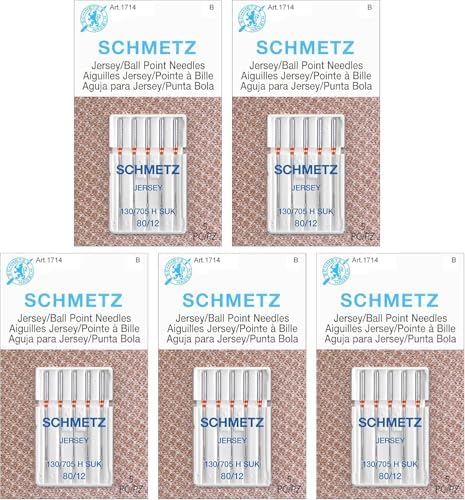
Fit the ball point in whichever needle system your machine takes, and change both needles together. SCHMETZ makes a medium ball point version of the ELx705 serger needle for machines that use that system, and the household 130/705H family has ball point and jersey versions for machines that take those. Our serger needle guide covers how to find out which one your model wants.
Why Skipped Stitches Show Up on Knits First
A cut or stretched loop does not present a clean channel for the looper thread, so the point shape shows up as skipping long before it shows up as damage. If your machine only misbehaves on stretchy fabric, change the needle before you touch anything else, and follow the skipped stitch checklist if it persists.
Setting Up for Knits
Three purchases cover almost everything, and none of them is a machine. The picks below are in the order they change your results.
Needles First
Ball point needles in your machine’s system, in the size that matches the weight of the fabric. This is the cheapest change on the list and the one that visibly alters the seam. Keep a pack for knits separate from the pack you use on wovens, because they get mixed up otherwise.
Thread That Sits Soft
Woolly nylon is a texturized thread that blooms in the seam and fills the stitch, so the wrap lies soft against skin instead of like a row of tiny knots. It belongs in the upper and lower loopers, never the needles, and it is the standard answer for swimwear, leggings and anything a child will wear next to the skin.

Holding Knits Without Distorting Them
Pins leave holes in fine jersey and drag the edge out of shape as you feed. Clips hold the layers at the edge without pressing into the fabric, and they come off in front of the knife rather than getting eaten by it. There is more on the trade in our clips versus pins comparison.

Keeping Shoulder Seams From Growing
Clear elastic sewn into a shoulder or neckline seam stops it stretching out over a year of being pulled over a head. It feeds under the foot with the seam and adds almost no bulk, and it is the detail that makes a home made t-shirt keep its shape like a bought one.

What the Serger Still Cannot Do
It cannot hem. A serger finishes and joins at the edge, so the flat double row hem on the bottom of a t-shirt is a different machine or a twin needle on your sewing machine. That is the one gap in an otherwise complete knit setup, and it catches people out on their first project.
It also does not replace your sewing machine for topstitching, buttonholes or anything that happens away from an edge. Our coverstitch and serger comparison sets out which machine does which half of a knit garment, and the serger guide covers the stitches it does produce.
Frequently Asked Questions
Do I need differential feed to sew knits? You need it to sew them well. Without it, seams in stretchy fabric come out longer and wavier than the pattern piece. Nearly every current home serger has the dial, so this is less a buying decision than a setting you have to learn to use.
What number should the dial be on? Slightly above one for most jersey and rib, one for stable knits like ponte and fleece, and below one only when you actually want a ruffled lettuce edge. Test on a scrap of the same fabric every time, because the right number changes with the fabric.
Why is my knit seam wavy even with differential feed? Either the setting is not high enough yet, or you are helping the fabric through by pulling behind the foot. Let the machine feed and guide only at the front. Presser foot pressure also matters if your machine lets you adjust it.
Can I sew knits without a serger at all? Yes. A narrow zigzag or a stretch stitch on a regular machine holds fine, and a ball point needle matters just as much there. The serger gives you the clean finished edge and the speed, not the ability itself.
Does woolly nylon go in the needles? No. It is a texturized thread designed to fill the stitch from the looper side and it does not behave in a needle eye. Keep regular cone polyester in the needles, and see our serger thread guide for the full set.
The Bottom Line
Sewing knits well on a serger comes down to three settings and two purchases. Put a ball point needle in, set the differential feed slightly above one, test on a scrap of the actual fabric, and add woolly nylon in the loopers when the seam touches skin. The machine matters far less than most buying guides suggest, because any current serger with a differential dial can do this. Read next: ballpoint versus universal needles and what a serger does that your machine cannot.