Last updated: August 22, 2026
Denim is not one fabric. A pair of stretch jeans is a light knit blend with a bit of cotton twill personality, and a raw selvedge jean is a stiff, dense weave that fights back. Both get called denim, and the machine that shrugs at one can stall on the other.
The good news is that most denim trouble is solvable with three cheap things: the right needle, the right thread and a way to keep the presser foot level over the side seam. This guide sets those out first, then covers the machines worth buying if denim is a regular part of your sewing.
This article contains affiliate links. If you buy through them, we may earn a commission at no extra cost to you. Learn more.
Quick Answer
What do you need in a sewing machine for denim?
- A jeans needle, size 100/16 for heavyweight denim and 110/18 for extra heavy or multi layer seams.
- A presser foot that lifts high enough to climb onto a flat felled seam, plus adjustable foot pressure if the machine offers it.
- A metal internal frame so the machine stays still when the needle meets resistance.
- Stitch length set longer than your usual setting, around 3 to 3.5 mm, so the stitches do not pack up in the weave.
Bottom line: buy needles and a height compensation tool before you buy a machine. If denim is weekly work, a metal framed mechanical machine is the sensible upgrade.
The Needle Does Most of the Work
A jeans needle has a sharp point and a stiffer blade than a universal needle, so it pierces a dense twill instead of deflecting off it. Needle makers point to size 100/16 for heavyweight denim and 110/18 for extra heavy or multiple layer seams. That single change fixes most skipped stitches on denim.
Change the needle at the start of a denim project rather than when it snaps. A needle that has already sewn twenty hours of cotton has a rounded tip, and a rounded tip on dense twill is exactly the recipe for a broken needle at the seam crossing. Our needle guide covers when to change and why.

Universal Needles Are the Wrong Tool Here
A universal needle has a slightly rounded point so it can cope with knits and wovens alike. That compromise is what makes it deflect on dense denim. If you are getting skipped stitches on jeans and you have not checked which needle is in the machine, check that before anything else. There is more in which needle for which fabric.
Thread and Stitch Length
All purpose polyester thread holds a denim seam perfectly well. Where people go wrong is the topstitching, the contrast stitching that runs along the seams, which needs heavier thread and a needle with an eye big enough to carry it. Do not try to make ordinary thread look like topstitching by sewing over it twice.
Set the stitch length longer than your default. Around 3 to 3.5 mm keeps the stitches from packing into the weave and gives the seam room to move. Short stitches on heavy denim look crowded and perforate the fabric along a line, which is where jeans eventually tear.

Getting Over the Side Seam
The flat felled side seam is where hems go wrong. The foot tips upward as it climbs, the needle deflects, and either the stitch skips or the needle breaks. A height compensation tool, often sold as a hump jumper or a leveling plate, sits behind the foot and keeps it flat while it crosses.
Do the same job by hand if you do not have one. Stop with the needle down before the bump, lift the foot, slide a folded scrap of denim under the back of the foot, lower it again and turn the handwheel by hand across the thickest point. Slow and manual beats fast and hopeful here.

Machines Worth Buying if Denim Is Regular Work
You do not need a special denim machine. What helps is mass, metal and a high presser foot lift, so the machine stays put and the foot clears the bulk. Two of the three below sit in normal retail rather than the dealer channel, which keeps them realistic for a home budget.
The Straightforward Mechanical Choice
Singer lists the Heavy Duty 4423 with a metal interior frame, a stainless steel bedplate, an extra high presser foot lifter and adjustable presser foot pressure. That combination is what you want for jeans: stability, clearance and a way to stop the foot from pushing the layers apart. Our 4423 review is honest about the heavy duty label.

If the Machine Has to Be Carried
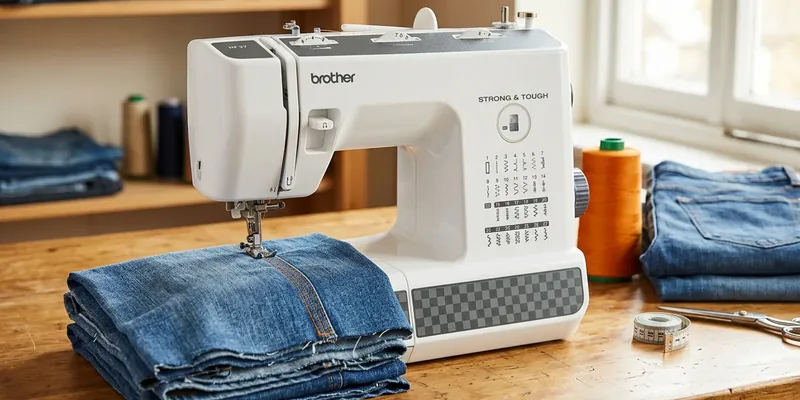
Brother lists the ST371HD with a metal needle plate, a jam resistant drop in bobbin and heavyweight needles included. It is lighter than the metal framed alternatives, which is a genuine advantage if the machine lives in a cupboard, and a small disadvantage on the heaviest seams where mass helps.

Denim Weights and What They Ask For
Denim is sold by weight per square yard, and that number tells you more than the word denim does. Lighter shirting denim behaves like a firm cotton. Heavy raw denim behaves like canvas. Match the needle to the weight rather than to the garment type.
| Denim type | Feels like | Needle size | Watch out for |
|---|---|---|---|
| Stretch jeans | Soft, gives under the foot | Stretch or jeans 90/14 | Skipped stitches from the wrong point shape |
| Shirting denim | Firm cotton | Jeans 90/14 | Puckering if the stitch is too short |
| Standard jeans | Dense twill | Jeans 100/16 | The flat felled side seam |
| Raw or heavy denim | Stiff, close to canvas | Jeans 110/18 | Needle deflection at seam crossings |
Needle sizes above follow the sizing guidance published by needle makers such as Schmetz. If you are between sizes, go up rather than down, because a needle that is slightly too large leaves a hole and a needle that is too small breaks.
Frequently Asked Questions
Can a regular sewing machine sew denim? Yes, for hems, repairs and single layer seams, provided you fit a jeans needle and lengthen the stitch. Where a light machine struggles is the seam crossing on heavy jeans, and the fix there is a height compensation tool and the handwheel rather than a new machine.
What needle size do I need for jeans? Needle makers point to 100/16 for heavyweight denim and 110/18 for extra heavy or multiple layer seams. Lighter stretch jeans do better on a 90/14. Use a jeans or denim needle rather than a universal one, because the point shape is what stops the skipping.
Why does my machine skip stitches on denim? Almost always a blunt or wrong needle, and after that a threading fault. Rethread with the presser foot up, fit a fresh jeans needle in the right size, and try again before you touch the tension. Our guide to skipped stitches works through the order.
Do I need special thread for denim? Not for construction seams, where all purpose polyester is fine. Topstitching is different: it needs a heavier topstitch thread and a needle with a larger eye. See our topstitch thread guide for the pairing.
How many layers can a home machine handle? That depends on the weight of the denim rather than the layer count, which is why the number in the listings is rarely useful. We look at what actually happens at the seam crossing in how many denim layers a home machine handles.
The Bottom Line
Fix the needle, the thread and the seam crossing before you shop for a machine, because those three account for most of the frustration people blame on their equipment. If denim really is weekly work, a metal framed mechanical machine with a high foot lift is a sensible upgrade and will still be running in ten years. Read next: how many denim layers a home machine handles and our Singer 4423 review.