Last updated: August 22, 2026
Hemming pants is the job that sells more sewing machines than any other. Somebody buys trousers that are two inches too long, gets quoted a tailoring price that is a fair chunk of what the trousers cost, and works out that a machine pays for itself in five pairs. Then they discover that a jeans hem has a lump at the side seam that stops a light machine dead.
So there are really two questions here. Do you need a machine at all, and if you do, what kind of hem are you doing. The answer for suit trousers is different from the answer for jeans, and buying the wrong side of that line is the most common mistake in this category.
This article contains affiliate links. If you buy through them, we may earn a commission at no extra cost to you. Learn more.
Quick Answer
What sewing machine do you need for hemming pants?
- A free arm, so the pant leg slides around the needle instead of being wrestled flat.
- A blind hem stitch and the matching foot, if you want an invisible hem on dress trousers.
- Enough weight and motor for denim, if jeans are the reason you are buying. A light machine stalls at the side seam.
- The right needle. A denim needle for jeans, a universal for suiting, a ballpoint for knit joggers.
Bottom line: match the machine to the heaviest pants you own, not to the average pair.
The Two Hems You Will Actually Sew
An invisible hem is what you want on suit trousers, chinos and anything with a smooth face. The blind hem stitch catches only a thread or two of the outer fabric every few stitches, so from the front you see almost nothing. It needs the blind hem stitch on the dial and the foot with the guide bar.
A topstitched hem is what jeans have: a visible line of stitching, usually in a contrast thread, sewn straight through the folded layers. It is faster and stronger, and the difficulty is not the stitch but the bulk where the side seams cross.
Why the Side Seam Stops Machines
At the outseam of a pair of jeans, the folded hem crosses two flat felled seams, which is a sudden step in thickness. A machine climbing that step lifts the front of the presser foot, which is why the stitches bunch up right at the seam or the needle stops moving. Weight, motor and presser foot lift are what get you across it.
Machines by the Pants You Own
Pick on the heaviest thing you will hem, because that is the point where the machine either works or does not. Everything lighter is easy for any of these.
Best for Dress Pants, Chinos and Everyday Hems
A mid range computerized Brother covers this comfortably and gives you the blind hem stitch and foot without hunting for them. Brother lists 70 built in stitches and ten included feet for the CS7000X, and the free arm makes the pant leg straightforward. It is the machine most people mean when they say they want one machine that does everything at home.

Best If Jeans Are the Reason You Are Buying
Singer’s heavy duty line is the standard answer for denim hems at home, and the 4423 is the model most people land on. Singer lists a maximum of 1,100 stitches per minute and a metal interior frame. Heavy duty is a marketing label rather than a standard, but on this machine it does correspond to real things: more weight on the table and a higher presser foot lift. Our 4423 review goes through what it does and does not do.

The Needle That Decides the Result
More hems fail on needle choice than on machine choice. Denim needles have a stronger shaft and a sharper point that goes through layered twill instead of deflecting off it. Suiting takes a universal, and knit joggers take a ballpoint. A pack of each costs less than one tailoring bill.

The Tool That Gets You Over the Lump
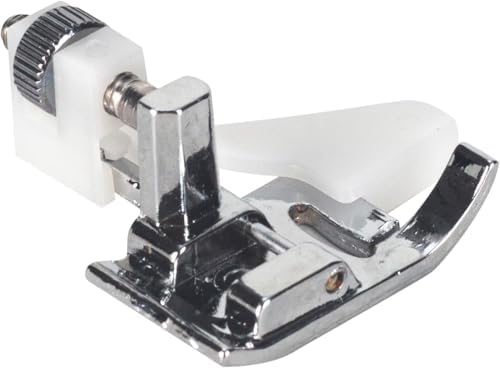
A small leveling block, sold as a hump jumper or a button reed, sits under the back of the presser foot so the foot stays level as it climbs the seam. It costs almost nothing and it is the difference between a neat line of stitching across the outseam and a knot of bunched stitches.

For an Invisible Hem
If your machine has the blind hem stitch but you have never found the foot, that is the missing piece. The foot has an adjustable guide that rides against the fold, which is what keeps the zigzag catching just one or two threads of the outer fabric rather than a visible bite.
What Each Route Costs You
Not everyone should buy a machine for this. Four routes exist and three of them are cheaper than the machine, so it is worth being honest about where the line is.
| Route | Result | Time per pair | Worth it when |
|---|---|---|---|
| Hand blind stitch | Invisible, strong | Half an hour or so | One or two pairs, no machine |
| Iron on hem tape | Temporary, stiff | Ten minutes | A costume or a one time fix |
| Tailor or alterations shop | Best on jeans with the original hem kept | Drop off and collect | Occasional pairs, or a suit you care about |
| Your own machine | As good as your setup | Fifteen minutes | You hem several pairs a year |
Our no machine guide covers the hand and tape routes properly, including which one survives the laundry.
Getting the Hem Right
Measure with the shoes on. Turn the pants inside out, pin the fold, then try them on again before you cut anything. Press the fold hard with steam, because a pressed fold sews far more accurately than a pinned one, and on most fabrics the press does more for the finished look than the stitching does.
Then sew with the free arm section removed so the leg turns freely, and go slowly across the seam crossings. On jeans, using the leveling block and a longer stitch length across the bulk keeps the line even. On dress trousers, test the blind hem on a scrap of the same fabric first, since the bite depth changes with thickness.
Keeping the Original Jeans Hem
There is a technique where you shorten the leg above the original hem and reattach the factory finish, which keeps the worn edge and the contrast stitching intact. It works on any machine that can get across the bulk, and it is why alterations shops charge more for jeans than for chinos.
Frequently Asked Questions
Can a cheap sewing machine hem jeans? Light machines struggle at the side seams, where the folded hem crosses the flat felled seams. A basic machine will hem chinos and dress pants fine. For denim, weight, motor and a denim needle matter more than stitch count.
Do I need a blind hem foot? Only for an invisible hem. A topstitched hem needs no special foot. If you hem dress trousers regularly the foot is worth having, because getting a consistent shallow bite by eye is difficult.
Can a handheld machine hem pants? No. The motor stalls in folded layers and the single thread chain stitch is not strong enough for a hem that gets walked on. Handhelds are for hanging curtains and repairs in place, as we set out in the handheld guide.
What needle size for hemming jeans? A denim needle in a heavier size is the standard choice, and the package will tell you which sizes suit denim weights. Change it after a couple of pairs, since a blunted point is the usual cause of skipped stitches on twill.
How do I stop the stitches bunching at the seam? Use a leveling block under the back of the foot so it stays flat as it climbs, slow right down, and lengthen the stitch across the bulk. Do not pull the fabric through, since that bends the needle.
Is a serger useful for hemming? Not for the hem itself. A serger finishes the raw edge before you fold it, which is worth doing on fraying fabric, but the hem stitching still happens on the sewing machine.
The Bottom Line
Buy for the heaviest pair in your closet. Dress pants and chinos need a free arm, a blind hem stitch and the matching foot, all of which come standard on any mid range machine. Jeans need weight, motor and a denim needle, plus a leveling block for the side seams. If you hem two pairs a year, the tailor is still cheaper than any of it. Read next: hemming without a machine and our beginner machine guide.