Last updated: August 22, 2026
A child who wants to sew usually wants to make one specific thing: a bag for a doll, a pillow shaped like an animal, a costume for a school play. What they need is a machine that will run slowly enough for them to steer, sit still on the table, and be threaded by an adult in under a minute. What gets bought instead is often a toy sized machine in bright plastic that does none of those three things well.
The awkward truth is that the best sewing machine for most children is a real one with a speed limiter, not a machine marketed at children. That is not a snobbish position. Small novelty machines are harder to thread, less stable, and more likely to jam, and a jam is what ends a child’s interest in an afternoon.
This article contains affiliate links. If you buy through them, we may earn a commission at no extra cost to you. Learn more.
Quick Answer
What should you look for in a sewing machine for kids?
- A speed limiter that caps the top speed regardless of how hard the pedal is pressed. This is the one feature that matters most.
- Enough weight to stay put. A machine that slides when a child leans on it is harder to control, not safer.
- A finger guard around the presser foot if one is offered, and a needle area that is easy to see.
- Simple threading, because an adult will be doing it and doing it often.
Bottom line: a full size machine with a speed slider usually beats a toy sized one, with an adult in the room either way.
Why the Speed Limiter Is the Whole Decision
A sewing machine responds to pedal pressure, and a child’s foot control is not yet fine grained. Press slightly too hard and the machine bolts, the fabric runs away, and the instinct is to grab it, which is exactly how fingers get near the needle. A speed slider removes that failure mode entirely.
It works by capping the maximum speed no matter how hard the pedal goes down, so the machine simply cannot run away. Computerized machines commonly include one, often alongside a start and stop button that runs the machine without a pedal at all. That combination is worth more than any child specific styling.
Safety, Briefly and Without Drama
Sewing machines have one hazard worth naming: a needle moving fast, close to fingers. It is a real risk and a manageable one. Speed control, a finger guard, the power switched off for needle changes and an adult nearby cover it, and most sewing children never have an incident at all.
A finger guard is a small clear shield that curves around the presser foot area, keeping fingers from reaching the needle while leaving the work visible. Some machines aimed at younger sewers include one; on machines that do not, the substitutes are a slow speed setting, a clear rule about where hands go, and supervision. Ages vary enormously by child, so judge the individual rather than a number, and stay in the room the first several times.
Full Size With a Slider, or a Small Kids Machine
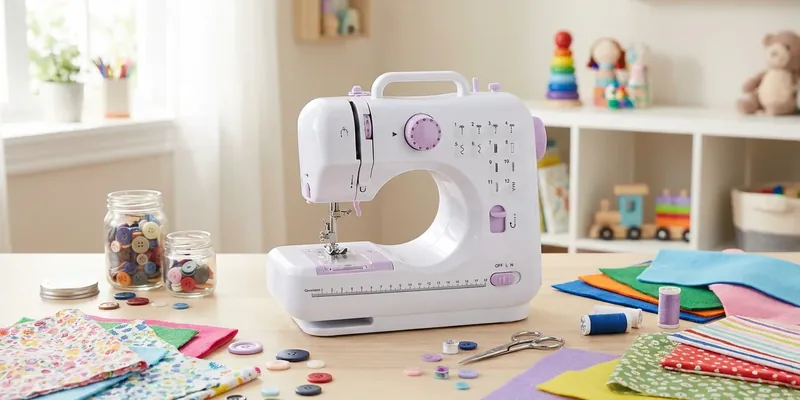
Full size machines with speed control are steadier, thread more easily, jam less and stay useful for years. Small machines marketed for children are lighter to carry, cheaper, and sometimes include a finger guard, but the very cheapest of them have a reputation for tension trouble and short lives.
Buyer feedback on the low cost mini machines is noticeably more mixed than on full size beginner machines, and the recurring complaint is threading and jamming rather than anything dramatic. If you buy one, buy it as a toy that sews rather than as a machine, and expect to be the one untangling it. Our page on which mini machines are real machines is blunt about where the line falls.
The Recommended Route: A Real Machine, Speed Capped
A mid weight beginner machine with an adjustable speed control slider, a drop in bobbin and a printed threading path. It suits a child from around the age they can sit at a table and follow two step instructions, and it is still the machine they use as a teenager. Adult threads it, child sews.

If You Want a Guard and a Smaller Body
Some compact machines aimed at younger sewers add a clear finger guard around the presser foot and a low fixed speed. They are genuinely easier to place in front of a small child, and they are more limited in what they will sew. Treat the guard as a useful extra rather than as permission to leave the room.

The Supplies That Prevent Most Frustration
Blunt tipped fabric scissors sized for small hands, plenty of pre wound bobbins so a change does not stall the afternoon, universal needles in a light to medium size, and cotton fabric that behaves. Slippery or stretchy fabric is what turns a fun afternoon into a tangle. See what belongs in a sewing kit.

What Each Option Actually Gives You
The table compares the three shapes people consider for a child, in the terms that matter on a kitchen table: how steady it is, how easy it is to thread, and how long it stays useful.
| Option | Speed control | Stability and threading | How long it lasts |
|---|---|---|---|
| Full size with slider | Capped, adjustable | Steady, easy to thread | Into adulthood |
| Compact kids machine | Often one low fixed speed | Light, guard sometimes fitted | A few years at best |
| Cheap mini machine | Usually two crude settings | Slides, fiddly threading | Often short |
| Hand crank toy machine | Child sets the pace | Very stable, chain stitch only | Early introduction only |
The hand crank row is worth a note for very young children. Machines that only work while a handle is turned cannot run away, which makes them a calm first introduction, but they generally form a chain stitch that pulls out easily. They teach the motion, not the sewing.
Setting a Child Up to Succeed
Thread the machine yourself, wind two or three spare bobbins in advance, and start with straight lines on plain cotton. Draw the lines on the fabric with chalk or a washable marker and let the child follow them. Success on day one is a straight seam, not a finished object.
Then pick a first project that finishes in one sitting: a small drawstring bag, a cushion cover, a doll blanket. Long projects lose children in the middle. Our list of first projects is written for adults but the early entries suit a supervised child perfectly well, and the first seam walkthrough is worth reading together.
Frequently Asked Questions
At what age can a child use a sewing machine? That depends far more on the individual child than on a number. The practical test is whether they can sit at the table, follow a two step instruction, and keep their hands where you ask. Supervise closely at first regardless of age.
Are child sized sewing machines safer than adult ones? Not automatically. A finger guard helps, but a light machine that slides on the table is harder to control, and a machine that jams constantly leads to grabbing and pulling. A full size machine with a speed limiter is often the safer practical choice.
Should a child use a foot pedal or a start and stop button? Whichever they can control. A start and stop button removes foot coordination from the task, which suits younger children. Some prefer the pedal because it feels like driving. Both are fine with the speed capped low.
Can a child use a regular beginner machine? Yes, and many do. Choose one with adjustable speed control, keep the setting low, change needles yourself with the power switched off, and stay nearby. See the beginner picks for models with a slider.
What should a child sew first? Straight lines on plain cotton scraps, then something small and useful in one sitting. A drawstring bag or a cushion cover works well. Avoid knits, slippery fabrics and zippers until the straight seam is comfortable, as covered in the beginner guide.
The Bottom Line
Buy for the speed limiter first, stability second, and child styling last. A full size beginner machine with a slider is usually the better purchase than a toy sized one, it threads more easily, jams less, and still gets used at fifteen. Add a finger guard if the machine offers one, switch the power off for needle changes, and stay in the room while the habit is forming. Read next: beginner machine picks for models with speed control and which mini machines are real machines before buying a small one.