Last updated: August 21, 2026
Thread is the one quilting decision that changes how the finished quilt looks from across the room. Piecing thread is invisible by design, buried inside a seam where nobody will ever see it. Quilting thread is the opposite: it sits on the surface, catches the light, and either disappears into the fabric or draws every line you stitched. Choosing between those two effects is the actual decision, and weight is how you make it.
The confusing part is that thread numbering runs backward. A higher number means a finer thread, so a fifty weight is thinner than a forty, which is thinner than a twenty eight. Once that clicks, the rest of the system is straightforward, and most quilters end up owning two or three weights rather than a wall of them.
This article contains affiliate links. If you buy through them, we may earn a commission at no extra cost to you. Learn more.
Quick Answer
Which thread weight should you use for quilting?
- For piecing, a fine thread that adds no bulk inside the seam. Fifty weight cotton is the standard answer.
- For quilting that sinks in, stay fine and match the color to the fabric.
- For quilting that shows, go heavier and let the stitch line become part of the design.
- Higher number means finer thread. That is the opposite of what most people assume.
Bottom line: decide whether you want the quilting seen or unseen, then pick the weight, and always test on a scrap sandwich first.
How Thread Weight Numbering Works
Thread makers number thread so that a higher figure means a finer strand. Fifty weight is finer than forty, forty is finer than twenty eight, and twelve weight is thick enough to look almost like embroidery floss on the surface. The numbers are a manufacturer convention rather than a legal standard, so the same number can vary slightly between brands.
Because of that, treat the number as a strong hint and the spool in your hand as the truth. Two forty weight cottons from different makers can feel noticeably different, and a heavier thread from a good maker can behave better in a machine than a thin one that sheds lint.
Where the Weight Shows Up in the Quilt
Inside a seam, thread bulk adds up. A quilt block has many seams meeting at the same intersections, and a fine piecing thread keeps those junctions from becoming lumps. On the surface, the opposite logic applies: heavier thread casts a visible line, which is precisely why people use it for feature quilting.
Cotton, Polyester and the Old Argument
Cotton is the traditional choice for cotton quilts, and it is what most quilters piece with. It has a matte finish that sits down into the fabric, it presses flat, and it behaves predictably. Its weakness is lint, which builds up under the needle plate faster than with a polyester thread.
When Polyester Earns Its Place
Polyester is stronger for its thickness and has more give, which makes it useful on anything that stretches or gets heavy use. It also holds color well in the wash. The traditional objection, that polyester cuts cotton fabric over time, comes from old industrial threads and is not the concern with modern quilting polyesters.
In practice most quilters use cotton for piecing and choose per project for the quilting layer, and both are defensible. The comparison in full is in our polyester against cotton thread article, and the general rules of thread weight and fiber are in the thread guide.
Thread by the Job
For Piecing Every Block
A fine cotton in a neutral color is what you want, and you will use a lot of it, so a large spool is more sensible than several small ones. Gray and beige hide against most fabric ranges better than white does, which is why experienced piecers keep both.

For Quilting That Should Disappear
Match the fiber to the top, stay fine, and pick a color close to the dominant fabric. Fine thread lets the texture of the quilting show as dimension rather than as a drawn line, which is what people mean when they say the quilting reads as texture.

For Quilting You Want to See
Go heavier. A heavier weight in a contrasting or deliberately chosen color turns the quilting into part of the design, which suits modern quilts with large open areas. Check the needle first, because heavier thread needs a larger eye to pass through without fraying.
For the Bobbin
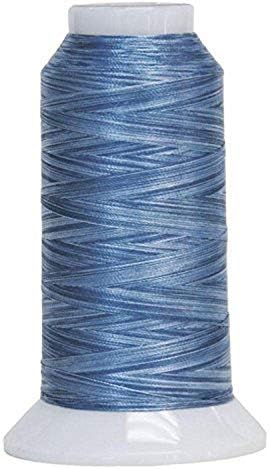
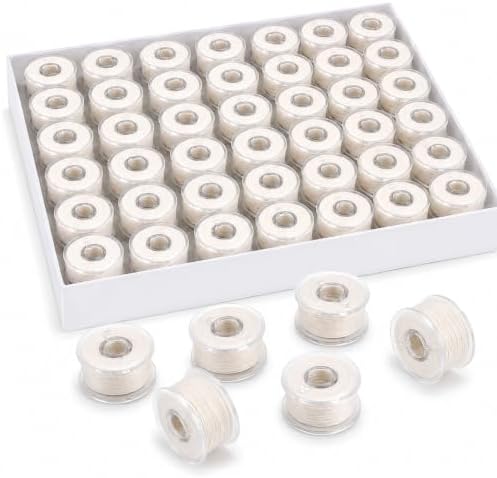
Many quilters run a finer thread in the bobbin than on top, especially with heavy decorative thread, to keep the back tidy and reduce bulk. Wind several bobbins before you start a session, because running out mid motif is the fastest way to leave a visible join.
The Weights Side by Side
These four cover almost every quilt. Remember that the numbers are maker conventions, so compare within a brand rather than across brands.
| Weight | How it looks | Typical use | Needle note |
|---|---|---|---|
| Fifty and finer | Almost invisible, no bulk | Piecing, quilting that sinks | Standard quilting needle sizes |
| Forty | Visible line, still subtle | General machine quilting | Larger eye helps, topstitch needle |
| Twenty eight | Clearly drawn stitch line | Feature quilting, hand look | Needs a larger eye, test tension |
| Twelve | Heavy, almost like floss | Big stitch and decorative work | Often hand stitched or top only |
Why Thread Breaks, and What It Is Usually Not
Breaking thread on a quilt is nearly always the needle, the threading path or the spool, in that order. A needle whose eye is too small for the thread frays it until it parts. A rethread with the presser foot raised fixes tension seating. An old spool that has gone dry and brittle snaps no matter what the machine does.
Change the needle, rethread with the foot up, and try a fresh spool before you touch a tension dial. The full diagnostic order is in our thread breaking article, and the needle side of it is in the needle guide.
Frequently Asked Questions
Can I use regular sewing thread for quilting? Yes. Ordinary all purpose thread pieces perfectly well and quilts acceptably. Dedicated quilting thread mainly gives you finer piecing weights and a wider range of surface weights and colors.
What is the difference between quilting thread and hand quilting thread? Hand quilting thread is usually glazed or waxed so it slides through the layers and resists tangling. That coating is not wanted in a machine, where it can build up in the tension discs, so check the label before using it on a machine.
Should the top thread and bobbin thread match? Not necessarily. Matching keeps tension behavior predictable, which is why beginners are told to match. Using a finer bobbin thread under a heavy top thread is a normal and useful exception.
Does old thread need throwing away? Not automatically, but thread that has sat in sunlight or in a dry loft can become brittle and snap. How to tell, and how to store the rest, is covered in our thread storage article.
How much thread does a quilt take? More than most people expect, especially with dense quilting. Buy one large spool of your quilting thread rather than two small ones, since dye lots vary and a color join mid quilt is visible. See also what a first quilt needs.
The Bottom Line
Pick piecing thread for invisibility and quilting thread for the effect you want on the surface, remembering that a higher number means a finer strand. Match the needle eye to the thread, wind spare bobbins before a session, and test everything on a scrap sandwich in the same materials as the quilt. Read next: setting the machine up for free motion and how thread weight and fiber work in general.