Last updated: August 21, 2026
Sixty stitches. It is printed on the box in a large font, and it is close to meaningless. Nobody sews sixty stitches. Most people who have been sewing for years use six, and one of those six is a straight stitch they use ninety percent of the time. So the honest question about the CS5055 is not what the sixty stitches are, but what else the money is buying.
It turns out there is a decent answer, and it is hiding in the parts of the listing that do not get a big font. A metal frame, a wider work area and a fixed needle bar are the sort of details that decide whether a machine feels precise, and they matter far more than stitch fifty seven.
This article contains affiliate links. If you buy through them, we may earn a commission at no extra cost to you. Learn more.
Quick Answer
What are you really buying with the Brother CS5055?
- Not the stitch count. Brother lists 60 built in stitches and you will use around six of them.
- A metal frame and a fixed needle bar, which Brother credits for cleaner, more even stitching.
- A wider needle to arm work area than the entry machines, plus computerized selection on an LCD.
- Seven included feet and Brother’s Quick Set drop in bobbin.
Bottom line: a solid mid range computerized machine, worth choosing for the frame and the work area rather than for the stitch library.
Where the Extra Stitches Actually Go
Of Brother’s listed 60 stitches, the genuinely useful group is small: straight stitch with needle position options, zigzag, a stretch stitch for knits, a blind hem, an overcasting stitch to stop raw edges fraying, and the buttonholes. Brother lists seven styles of one step auto size buttonhole, and that is a real spread rather than padding.
The rest are decorative. Scallops, stars, leaves, satin motifs, heirloom patterns. They are fun for a child’s blanket edge or a name on a bag, and most owners try them once. Nothing wrong with that, but it should not be the reason you choose one machine over another. Our stitch guide lists which ones earn their place.
The Frame Is the Real Upgrade
Brother describes the CS5055 as built with a durable metal frame, and credits it with handling projects from thick denim to heavy quilts. A metal internal frame reduces flex, and flex is what makes a light machine feel imprecise: the needle wanders slightly, the stitch length drifts, and it feels worse the thicker the fabric gets.
What a Fixed Needle Bar Adds
Brother also lists a fixed needle bar, which it says gives cleaner stitching and consistently even lines. In plain terms, less side to side play in the part that carries the needle means the needle lands in a more predictable spot every time.
Neither of these is dramatic on its own, and neither shows up in a product photo. Together they are the difference between a machine that feels vague and one that feels solid, which is the same quiet quality argument that pulls people toward the dealer brands, discussed in the Janome guide.

The Work Area Is Wider Than You Expect
Brother lists a large needle to arm workspace with increased width on this model. That space, between the needle and the upright body of the machine, is where the bulk of your project has to go, and it is the spec that quietly decides whether a quilt or a jacket is manageable.
It is not a quilting machine and there is no wide table in the box, so a full size quilt is still hard work. For piecing, garment sewing and lap sized projects the extra room is welcome, and an add on table can cover the rest, as covered in the extension table guide.
The Everyday Features That Matter More
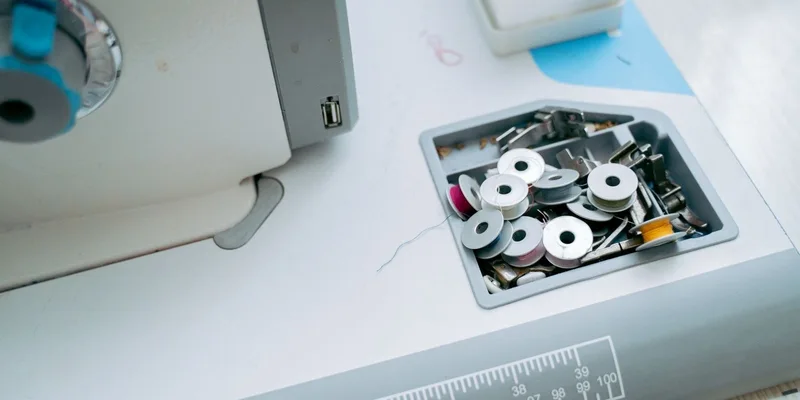
The Quick Set drop in bobbin sits under a clear cover so you can see when the thread is running out. Brother lists an advanced needle threading system, a fast bobbin winder and an LED lit work area. These are the things you interact with twenty times an evening.
Seven Feet in the Box
Seven included presser feet cover buttonholes, zippers, blind hems, buttons and overcasting. That is enough to sew clothes without buying anything extra for a while, which is worth more at this price than another twenty decorative stitches would be.
The feet you may want later depend on what you take up. A walking foot if you sew knits or quilt layers, a quarter inch foot if you piece, a nonstick foot if you touch vinyl. What each one does is set out in the presser feet reference.

CS5055 Against the CS7000X
These two get cross shopped constantly. The differences are small but consistent, and they come down to whether you need the table.
| Model | Stitches listed | Wide table | Choose it if |
|---|---|---|---|
| Brother CS5055 | 60, LCD selection | Not included | Garments and general sewing, smaller footprint |
| Brother CS7000X | 70, LCD selection | Included, detachable | Quilting and larger projects |
| Brother GX37 | 37, dial | Not included | You do not want a screen at all |
| Brother ST371HD | 37, dial | Not included | Denim, canvas and repairs |
Who Should Not Buy It
Anyone whose sewing is hemming and mending, because a mechanical dial machine does that for less and with fewer things to learn. Anyone who mainly quilts, because the model with the wide table in the box is the better value. And anyone whose real problem is thick material, because the answer there is needles, thread and feet.
Everyone in between, which is a lot of people making clothes and household items, is well matched here. If you are still deciding whether a screen belongs on your machine at all, work through computerized or mechanical first, because that question comes before the model number.
Frequently Asked Questions
Is the Brother CS5055 good for beginners? Yes. Computerized selection is not harder than a dial once you have used it twice, and the speed control that comes with this tier helps new sewers more than any stitch. See what actually matters in a beginner machine for the full checklist.
What is the difference between the CS5055 and the CS7000X? Mostly the stitch count and the wide table. The CS7000X includes a detachable wide table, which is the deciding feature if you quilt. Both share the same general computerized approach, as covered in the CS7000X review.
Can the CS5055 quilt? It pieces well and handles small quilts, and Brother’s own description mentions heavy quilts among the things the frame is built for. Without an included wide table, larger quilts are awkward, so add a table or choose the model that includes one. See the quilting guide.
Does the CS5055 sew knits? Yes, with a ballpoint or jersey needle and a stretch stitch. Skipped stitches on knits are almost always the needle rather than the machine, which is the first thing to check in the skipped stitch guide.
What bobbins and feet does it take? It uses the standard drop in plastic bobbin class that Brother specifies in the manual, and it is a low shank machine, so most low shank snap on feet fit. Confirm both in your manual before buying accessory sets in bulk.
The Bottom Line
Ignore the sixty stitches and buy the CS5055 for the metal frame, the fixed needle bar and the wider work area. It is a mid range computerized machine that feels more precise than the entry tier, with enough feet in the box to sew clothes properly from day one. If quilting is the goal, the model with the wide table included is the better buy. Read next: the CS7000X review, and the Brother lineup explained.